
Who Am I?
My name is Rob Manson and I’m an independent AI interpretability researcher. I develop geometric methods for measuring what happens inside neural networks - how representations form, move, and can be measured - and how that measurement changes what we can say about model safety and reliability.
My framework, Curved Inference, is peer-reviewed (in Artificial Intelligence and Applications) and has been independently cited and extended by another research group, who applied the same trajectory-geometry paradigm to dense and mixture-of-experts models up to 32B parameters, including on a safety-relevant target. Alongside the framework I develop pre-registered methodology, designed to be adversarial against itself, that catches measurement errors in current interpretability practice. My most recent paper, Align-IT, even caught one of its own pipeline failures. This work sits at the intersection of AI safety, mechanistic interpretability, and the reliability of the latent models the field is now converging on.
Underneath the methods sits a deeper question I’ve worked on for years: how systems come to model self, other, and world at all. The geometric framework that addresses it, FRESH, is the engine that generates the predictions these instruments test - it’s the “why” beneath the measurement work, not the headline.
Background
For around twenty years I led R&D teams in computer vision, augmented and virtual reality, and machine learning, including remote and distributed teams for over a decade. I’m proud of the work our teams shipped, including a number of world firsts, and I served as an Invited Expert for the W3C, the Khronos Group, and the International Standards Organisation, contributing to the standards underlying interactive 3D and the web.
After a serious health event, I spent two years on self-directed research. The body of work on this site is its output: a peer-reviewed publication, an arXiv paper, a second paper under review, open-source tooling, and an ongoing public research program.
The Longer Arc
This research traces back further than the recent work. In 2010 (around 15 years ago as I write this) I started exploring some ideas that at the time seemed pretty fringe. They have now evolved into this research program.
It’s a long read and I don’t expect you to look through it in detail, but if you want to skim through, then here’s a link to a document I posted way back in 2010. The Pervasive Experience Project - July 2010

The starting point for this whole thing was a single diagram drawn by the late Marc Weiser. Unfortunately, his original website is now badly broken, even in the internet archive, and all I have left is this poor quality copy from my 2010 document.
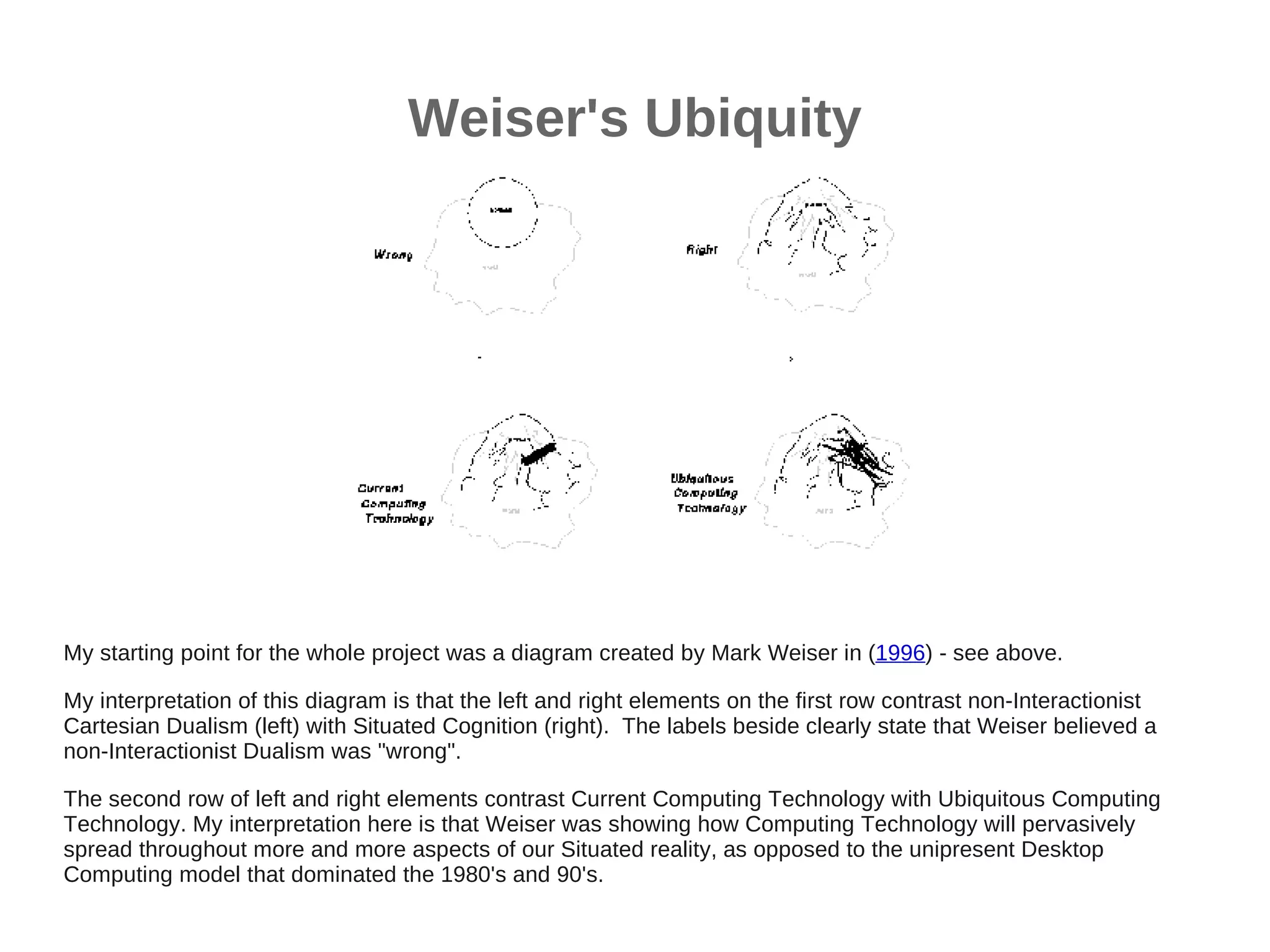
Sadly it seems even the web is now getting its own form of alzheimers.
Research Philosophy
Four principles guide this work:
1. Operationalise or abandon
If a concept can’t be measured or tested, either find a way to operationalise it or stop talking about it. Phenomenology is valuable, but hand-waving isn’t.
2. LLMs as instruments, not subjects
I use LLMs as experimental platforms for testing theories about cognition - not because I claim they’re conscious, but because they’re systems where geometric methods can be applied and predictions falsified.
3. Build in public
Research develops faster with feedback. I share work-in-progress, negative results, and open problems. Code and data are public. Methods should be reproducible.
4. Pre-register and test against yourself
The strongest check on a measurement is whether it survives an attempt to break it. I pre-register predictions, build in adversarial controls, and treat a method that catches its own errors as a method working as intended. A genuine signal should strengthen under scrutiny, not vanish.
Contact & Collaboration
I’m always glad to hear from people whose work connects with this, and I’m open to research collaborations and grant-supported projects. I’m particularly interested in working with:
- AI safety and interpretability researchers working on model reliability, deception detection, and computational self-models
- Researchers applying geometric or trajectory-based methods to multimodal and embodied systems
- Consciousness scientists and computational phenomenologists interested in geometric approaches
- Philosophers of mind who want to test phenomenological predictions empirically
GitHub: robman
Bluesky: https://bsky.app/profile/robman.fyi
LinkedIn: https://www.linkedin.com/in/robertmanson/
How to Follow This Work
Weekly updates: Subscribe to Latent Geometry Lab
Research program: Overview
Papers & code: Publications · GitHub